
Key Takeaways
- 01A construction contract is a legally binding document that protects both contractor and owner from disputes
- 02Essential elements include project scope, timeline, payment terms, insurance details, and dispute resolution clauses
- 03Six main contract types exist: lump-sum, cost-plus, unit pricing, time and materials, guaranteed maximum price, and custom
- 04Always consult a construction attorney to ensure your contract complies with local and state laws
- 05A well-drafted contract prevents payment delays, scope creep, and costly legal disputes
Every construction contractor must have faced some challenges starting from sending estimates to invoices and even after that. Articulating a construction contract is as difficult as constructing a house. But since you are an expert in the latter part, leave the former part to us. This article is on how to write a construction contract agreement; from its importance to different types and factors to consider to let you know the authorized person who writes the construction contract.
What is a Construction Contract and Why is it Important?
A construction contract is a legally binding document containing every piece of information related to construction either from scratch or by modifying the existing one. Both owner and construction contractor sign this document giving mutual consent. The construction contract compiles of a certain set of things:
- Work to be done
- Start and completion of the project
- Parties to be involved in constructing
- Labor and material costing
- Communication channel
- Amendments in the project
- Dispute resolving clause
Now that you know what a construction contract is, let's know the importance of having one before initiating construction work.
Having a duly signed construction contract on your side means a sense of guarantee. You are secured and so are your customers. Without this document, you risk payment delays, scope creep, and financial instability in your business.
For instance, if you haven't signed a construction contract, there are chances of your customer delaying payments or making excuses. Not getting timely payments would financially disturb your business.
Another possibility could be that your customer cannot demand extra work. Whatever is stated in the contract, you have to do only that much work.
In nutshell, the construction contract is a guarantee that you, as a contractor, have to complete the work/project, and in return, you would be compensated in a stipulated period.
Since the construction contract is a significant document, you must know how to create one. Knowing this piece of information would make your work easier when actually trying to create one.
How to Make a Construction Contract?
Like every other contract, this one also involves several laws. That's one of the reasons you need a construction lawyer with years of experience in creating and making a document legally binding. You can even reuse the draft for future projects. Besides, if you learn how to become an construction estimator, then it would be a cherry on the cake.
Some essential steps to consider while writing a construction contractor:
Define the Purpose of Contract
You must write the purpose of the contract. For instance, if house-building is the purpose, you must explicitly mention it. Apart from this, it should also include the parties involved, project location, inception, and completion of the project date.
Add Essential Elements
We have discussed different elements to be included in a home-making contract. Other than this, you must include a timeline of the project, payment structure, and insurance details.
Add Critical Clauses
What you should not miss when creating a construction contractor is the list of 5 different clauses: payment terms clause, contract sum amount, terms related to handling changes in the contract, dispute resolving clause, and claim resolving clause. All these clauses are crucial and important, and they are considered to protect the interest of contractors.
Get a Second Opinion
You must include an expert with the knowledge of local, state, and federal law. This way, your construction contractor would be error-free.
Here's how to structure your construction contract from start to finish:
- Start from the top of the contract paper where you need to mention the title, date, and time. Along with that, there should be a company name and logo written in bold letters. In this part, you need to mention details of the project like the location and type of job.
- Following that, make another section to add financial & insurance information, the project timeline, and the insurance coverage policy.
- During the formation of the agreement, there should be a clause that is suitable for your project work. We recommend you contact an attorney to pick the correct clause for your project. It will include potential uncertainty like natural calamities and severability.
- Thereafter, mention the necessary rules and laws in your contract. Adding such things will give a professional tone to your construction contract. Also, it means that you are considering all the local laws and state guidelines.
- Once you are done with the necessary information in the contract, send it to the expert to recheck if you missed out any points. Also, you can ask your attorney to have a close look at the agreement.
What Are the Different Types of Construction Contracts?
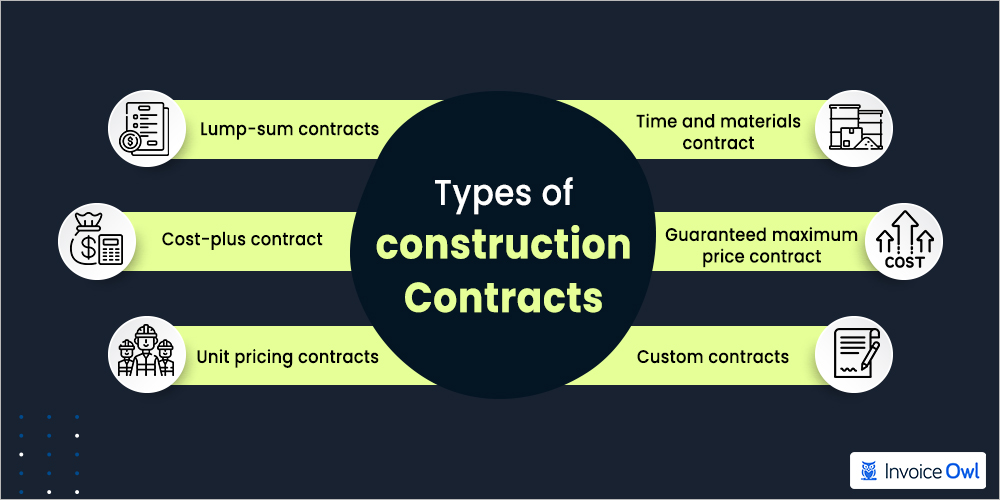
1. Lump-sum contracts
A fixed fee is agreed upon for the entire construction project in these fixed-price contractual arrangements. There are no bifurcations for different costs. The fees of the general contractor are also included in the project amount. The contractor, therefore, tries to keep the expenses tight so as to extract maximum profits. Thee are several other money-making strategies in the construction business to bag a good amount of profits.
2. Cost-plus contract
This arrangement encompasses proper segregation of the cost of materials used and labor utilized in the construction process. The plus part denotes the commercial construction profit margin to the general contractor, which could be flat fee or percentage of the contract price.
3. Unit pricing contracts
These contracts are agreed to negotiate prices of different items, hourly payment rates, or space-wise cost break-up. The price of every unit is defined and paid for as per the agreement.
4. Time and materials contract
Such contractual agreements have some defined heads under which the payments are reimbursed or paid for by the owner. These heads are direct, indirect, overhead, and mark-up. An hourly rate is also defined for the contractor, which implies that they won't be entirely responsible for the supervision and will check for only those parts that are assigned to them.
5. Guaranteed maximum price contract
Such contracts specify a threshold up to which the owner will bear the project costs to control unmanageable expenses associated with the project. The general contractor shall pay for any expenditure over and above the defined threshold.
6. Custom contracts
If the parties involved do not intend to have a standard A101 contract for their association and instead want to get a custom-built contract for the undertaking, they can do so by discussing all the necessary pointers with a freelance writer who knows legal clauses, like a paralegal. The construction contract, once drafted, will then be reviewed and verified by an attorney and signed by both parties to bring it into force. The standard clauses will not be applicable to these construction contracts unless a clause has expressly been stated in these contracts. There are standard formats for the construction contracts which have all the clauses that such an agreement usually needs as per the contract types discussed above. The construction contract template could be used as is, or it can be used as a base structure to examine and use an updated contract with amended clauses.
What Should a Construction Contract Include?
Here are a few key elements that a construction contract should include:
Property and Owner Details
The details of the property like name and contact information should be mentioned at the top of the contract. Also add other details such as email id, phone number of the owner, complete address of the property, or company address if it's a commercial property, the size of the property, description of geography or prior construction, financial liabilities associated with the property and any other information which could be relevant to the legal implications on the land.
Contractor Information and Credentials
The details of the contractor regarding their license number and contact information such as email id, phone number, professional insurance liability, experience, and company detail should be described. The insurance coverage shall include the worker's compensation insurance as the construction contractor is responsible for paying the labor engaged in construction. The general liability is in the context of any discrepancies arising out of the construction contract agreement.
Project Timeline and Cost
The property owners usually choose a particular general contractor for the efficiency of work promised by them and the track record that they have had. Since there's a lot of money and effort involved in the new construction, there should be a pre-defined completion date, which must be religiously followed. The project cost for construction should also be premeditated and agreed upon to avoid legal action thereon.
Project Description
There should be a brief description of the project being handed over to the construction contractor to have just a preliminary vision of the project. This will give an idea of the project on which the entire discussion and the detailing are based. Otherwise, the perception of certain specifications could be misaligned from the actual portrayal of the intended solid construction contract agreement.
The steps mentioned above cover the preamble of the construction agreement to clearly define the essential information and the premise of the contract or agreement. You should know that the contract is not enforceable unless these details are incorporated and the counterparties sign the construction contract duly dated.
Rights and Obligations of Parties
The points described below pertain to the rights and obligations of the parties involved in the construction contract so as to free the project from any ambiguity:
- Non-refundable deposit: Since there are chances of dereliction, the contractor should secure a non-refundable deposit from the owner of the property before beginning the construction work. This way, the interest of the contractor is protected without having to follow up with the customer for payment.
- Scope of services: There should be a detailed description with an appropriate title for the project's scope of services of construction. The contractor payment terms of the project should also be clearly outlined for the work pursuant to completion of construction.
- Legal rights: The parties' legal rights should be explicitly mentioned in the contract for informational purposes, to have recourse in situations of liquidated damages, stop work, non-refundable deposit, and late fees.
- Payment withholding clause: The clause to withhold payment is critical to ascertain that the construction work turns out as planned. There should be legal action for the deviation in work from what had been decided, either in quality, the scope of work, time limit, or the total cost.
Additional Protective Measures
- To simultaneously protect the construction contractor, there is also a right to lien on materials that the contractor can exercise if the entire unpaid balance is impossible to proceed with the unit price of construction projects.
- The stop-work clause helps both the property owner and a general contractor by allowing a mechanism to exit the contractual agreement for construction if there are discrepancies from the other party's end in complying with the contract.
- The general contractor will be responsible for the main task of ensuring the work goes as planned and getting together a team of people. It will be in your hands to complete the project work and provide a warranty for hazardous things during the work.
- Since there is a lot of reliance on the work of sub-contractors and other experts, the general contractor usually handles the ultimate responsibility for performing the contractor agreement in the best spirit. This hand-over of responsibility takes a chunk of trouble off of the owner's head.
- A God clause is an unavoidable clause for unexpected situations that may arise during the course of a construction project that renders the contractor incapable of completing the contract.
This course of action should be defined for certain natural or legal hindrances, although it's unlikely that all the probable situations will be covered through sheer foresight. This leaves scope for legal advice and mutual arbitration for settling the work completed and proceeding with the remaining work.
Who Writes Construction Contracts?
Articulating a construction contract involves two to three different parties, such as the main engineer, business owner, and contract lawyer (if both are the same person).
Once the construction contract is written, it is sent to all the parties involved in different phases for evaluation and then it is signed and documented.
Whenever you decide to write a construction contract, make sure you hire a professional lawyer who is well-versed with local and state construction-related laws, rules, and regulations. This ensures your contract is legally enforceable and protects all parties involved.
So that's how you will write a construction contract considering the points of all the parties. The construction contract agreement is fundamental in ensuring work performance on the agreed completion date. The contract agreement builds pressure on the contractual parties to avoid being dubious and let the working sail smoothly through time and space. This is how construction contract documentation plays a significant role for both parties.
Besides the contract agreement, you should also give equal importance to making estimates and invoices. Let an invoice app for contractors reduce your workload.
Streamline Your Construction Business Documentation
Creating estimates and invoices shouldn't be as complex as drafting contracts. InvoiceOwl helps you create professional estimates and invoices in less than a minute, so you can focus on what you do best—building.
Start Your FREE TrialFrequently Asked Questions
The severability clause preserves the other provisions of a construction contract agreement as a whole when one of the clauses needs to be severed or is non-viable for performance due to some unavoidable circumstance. The remaining clauses and treatment of those remain unchanged, barring only the severed one.
When the home improvement work is supposed to be done in a calamity-prone area, where some foreseeable obstructions may hamper the project. In such cases, this clause will help the contractor to define their successors and assign the remaining job work to someone else. The assigned person will then take over the remaining work at the earliest.
The state boards authorize the license for the contractors to begin their work. The property owners should ensure whether a general contractor has a legitimate permit for taking up the construction assignment or not. Once authorized by the local administration, the contractor needs to follow their policies.
The most important clauses include payment terms, scope of work, project timeline, dispute resolution, payment withholding, stop-work provisions, and force majeure (God clause). Each protects different aspects of the contractual relationship between owner and contractor.
While templates can serve as a useful starting point, you should always have a construction attorney review and customize the contract for your specific project. Local and state laws vary, and a generic template may not adequately protect your interests.
Related Resources
10 Best Apps for Painting Contractors in 2026
Are you a painting contractor looking to boost productivity? Here are the best apps for painting contractors that can help scale your business to new heights.
Read more
6 Best Construction Estimating Software Contractors Should Try
Associated with the construction industry for a while? Explore 6 most popular estimator software to reduce your business paperwork. Follow the given steps to make construction estimates using automated accounting software.
Read more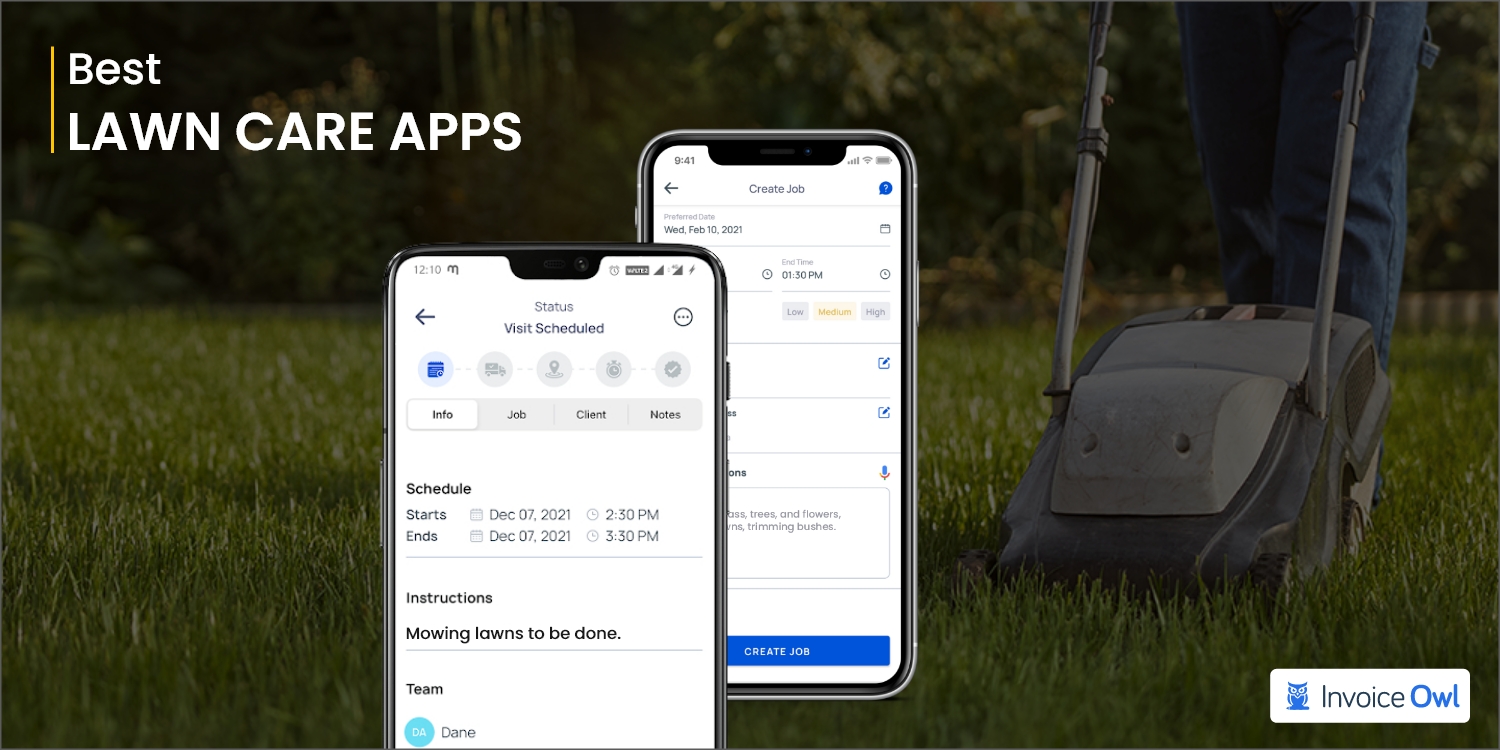
10 Best Lawn Care Apps for Contractors in 2025
Managing a lawn care business can be overwhelming without the right tools. Here are the best lawn care apps for contractors to effectively run their businesses.
Read more
11 Best Lead Generation Websites for Contractors
Go through the leading lead generation companies for contractors that can help you increase the quality of leads for your business.
Read more
Best Invoicing Software for Small Businesses (2025)
Compare the top invoicing software solutions for small businesses and contractors. Find detailed reviews, pricing, features, and user feedback to choose the right tool for your needs.
Read moreBest Invoicing Software for Small Businesses and Contractors
Pick the best invoicing software for your contracting business by comparing the best 11 invoicing software curated referring the user reviews on various platform.
Read more
15 Best Flooring Estimating Software: Complete Guide
Compare the top 15 flooring estimating software solutions. Detailed reviews, pricing, and features to help contractors make informed decisions.
Read more
How to Bid a Paint Job- Complete Estimation Process
Master bidding for paint jobs with expert insights on pricing, materials, labor, and insurance. Complete guide for painting contractors to boost profitability.
Read more10 Best Apps for Painting Contractors in 2026
Are you a painting contractor looking to boost productivity? Here are the best apps for painting contractors that can help scale your business to new heights.
Read more6 Best Construction Estimating Software Contractors Should Try
Associated with the construction industry for a while? Explore 6 most popular estimator software to reduce your business paperwork. Follow the given steps to make construction estimates using automated accounting software.
Read more10 Best Lawn Care Apps for Contractors in 2025
Managing a lawn care business can be overwhelming without the right tools. Here are the best lawn care apps for contractors to effectively run their businesses.
Read more11 Best Lead Generation Websites for Contractors
Go through the leading lead generation companies for contractors that can help you increase the quality of leads for your business.
Read moreBest Invoicing Software for Small Businesses (2025)
Compare the top invoicing software solutions for small businesses and contractors. Find detailed reviews, pricing, features, and user feedback to choose the right tool for your needs.
Read moreBest Invoicing Software for Small Businesses and Contractors
Pick the best invoicing software for your contracting business by comparing the best 11 invoicing software curated referring the user reviews on various platform.
Read more15 Best Flooring Estimating Software: Complete Guide
Compare the top 15 flooring estimating software solutions. Detailed reviews, pricing, and features to help contractors make informed decisions.
Read moreHow to Bid a Paint Job- Complete Estimation Process
Master bidding for paint jobs with expert insights on pricing, materials, labor, and insurance. Complete guide for painting contractors to boost profitability.
Read more10 Best Apps for Painting Contractors in 2026
Are you a painting contractor looking to boost productivity? Here are the best apps for painting contractors that can help scale your business to new heights.
Read more6 Best Construction Estimating Software Contractors Should Try
Associated with the construction industry for a while? Explore 6 most popular estimator software to reduce your business paperwork. Follow the given steps to make construction estimates using automated accounting software.
Read more10 Best Lawn Care Apps for Contractors in 2025
Managing a lawn care business can be overwhelming without the right tools. Here are the best lawn care apps for contractors to effectively run their businesses.
Read more11 Best Lead Generation Websites for Contractors
Go through the leading lead generation companies for contractors that can help you increase the quality of leads for your business.
Read moreBest Invoicing Software for Small Businesses (2025)
Compare the top invoicing software solutions for small businesses and contractors. Find detailed reviews, pricing, features, and user feedback to choose the right tool for your needs.
Read moreBest Invoicing Software for Small Businesses and Contractors
Pick the best invoicing software for your contracting business by comparing the best 11 invoicing software curated referring the user reviews on various platform.
Read more15 Best Flooring Estimating Software: Complete Guide
Compare the top 15 flooring estimating software solutions. Detailed reviews, pricing, and features to help contractors make informed decisions.
Read moreHow to Bid a Paint Job- Complete Estimation Process
Master bidding for paint jobs with expert insights on pricing, materials, labor, and insurance. Complete guide for painting contractors to boost profitability.
Read more