
Key Takeaways
- 01A standard house cleaning visit typically runs $120–$235 nationally in 2026, with most solo cleaners charging $30–$50 per hour and insured companies $45–$75 per hour
- 02Four pricing methods dominate: hourly, per square foot (roughly $0.08–$0.15 standard, $0.15–$0.30 deep), per room, and flat fee — most established cleaners move toward flat fees
- 03Deep cleaning usually costs 1.5–2.5 times a standard visit ($200–$500 for most homes); move-out cleans run $250–$600 because cabinets, closets, and appliances are included
- 04Your price floor is labor cost + overhead + profit margin — competitor rates tell you the market ceiling, not whether a job is worth taking
- 05Charge more for first-time cleanings, pets, clutter, and stairs; offer 10–20% off for weekly or biweekly recurring clients, who are worth more over a year than one-off jobs
If you run a cleaning business, the fastest way to answer "what should I charge?" is this: most standard house cleaning visits in the US go for $120 to $235 in 2026, most solo cleaners bill $30 to $50 per hour, and insured companies with employees bill $45 to $75 per hour, according to 2026 cost guides. Where you land inside those ranges depends on your market, the home, and how you package the service.
But quoting straight from a national range is how new cleaners end up working for free. Each business has its own costs — supplies, drive time, insurance, software — and each house is different. This guide walks through the four pricing methods cleaners actually use, current market rates for each service type, and a worked example showing how to build a price from your costs up instead of guessing.
Types of House Cleaning Services
When starting a cleaning company, decide which services you'll offer before you set prices, because each one is priced differently. Make sure your menu matches what's in demand in your area — here's a full rundown of the types of cleaning services you can offer.
Standard (Basic) House Cleaning
The bread-and-butter recurring service: dusting, vacuuming, mopping, wiping counters and surfaces, and cleaning bathrooms and the kitchen at a maintenance level. This is the service most weekly and biweekly clients buy, and it's where recurring revenue comes from.
Deep Cleaning
Everything in a standard clean plus baseboards, inside appliances, grout, light fixtures, and the hard-to-reach areas a maintenance clean skips. Deep cleans take roughly twice as long, and most cleaners require one as the first visit for a new recurring client.
Specialty and Add-On Services
Move-in/move-out cleans, post-construction cleanup, interior windows, inside the fridge or oven, and laundry. These are priced as separate line items or standalone jobs — a clear house cleaning checklist per service keeps your crew consistent and your quotes defensible.
6 Factors to Consider When Charging for House Cleaning Services
National averages are a starting point, not a quote. These six factors are what actually move a specific job's price up or down.
Labor
Labor is the largest share of a cleaning job's cost. Work out what an hour of cleaning actually costs you — wages (or the wage you pay yourself), payroll taxes, and paid drive time — before you look at anyone else's rates. Our labor cost calculator does this math for you. A house full of kids and pets takes meaningfully more labor than a tidy one-person home of the same size, and your price should reflect that.
Size of the Home
More square footage means more time. Most cleaners anchor their quote to the home's size — square feet or bedroom/bathroom count — then adjust for condition. Ask for the size up front, and when possible confirm it before locking in a flat rate.
Home Condition
Check photos or do a walkthrough before quoting. A poorly maintained house can take half again as long as a well-kept one, and pet hair adds time to every room. Most cleaners charge a premium — often 20–50% — for a neglected first-time clean, then drop to the standard rate once the home is on a maintenance schedule.
Local Demand
Rates in a major metro can run 30–50% higher than in a small town. Check what two or three established competitors in your area charge for a comparable home — not to copy them, but to know the ceiling your market will bear. If your cost-based price comes in well under local rates, raise it.
Frequency
Weekly and biweekly clients are worth more over a year than one-time jobs, so most cleaners discount recurring visits 10–20% off the one-time rate. The first visit still gets priced as a deep clean; every visit after that is faster because the home never gets far from clean.
Cleaning Type
A weekly maintenance clean and a once-a-year deep clean of the same house are completely different jobs. Price by service type, not just by house — and list add-ons (windows, fridge, oven, laundry) as separate line items so scope creep doesn't eat your margin.
Most cleaning companies offer a menu: routine cleaning, deep cleaning, move-out cleaning, and event cleanup. Quoting each as its own service — rather than one vague "cleaning" price — makes your estimates clearer and gives clients an easy way to spend more. An estimate maker that saves your service rates keeps those line items consistent from quote to quote.
Methods to Calculate House Cleaning Rate
Home cleaning companies typically price jobs one of four ways: by the hour, by square footage, by room, or as a flat fee.
House Cleaning Pricing Methods
| Method | Typical Range (2026) | Best For |
|---|---|---|
| Hourly Rate | $30–$50 solo, $45–$75 companies | New cleaners and unpredictable jobs |
| Square Footage | $0.08–$0.15 standard, $0.15–$0.30 deep | Standardized quotes across home sizes |
| Per Room | $75–$130 base + per-bedroom/bath add-ons | Quick phone quotes |
| Flat Fee | Priced per home from your hourly floor | Recurring clients and experienced cleaners |
Hourly Rates
Across 2026 cost guides, most solo house cleaners charge $30–$50 per hour, and insured companies with employees charge $45–$75 per hour. Dense metros run higher, rural areas lower. Hourly pricing is the easiest way to start because a misjudged house can't sink you — but it caps your income, because the faster and better you get, the less each job pays.
Don't cut your rate just to win volume. Price from your costs and leave a profit margin — and remember that with hourly billing, your revenue per job falls as you get faster. That's the main reason experienced cleaners migrate to flat fees.
Square Footage Method
Pricing per square foot standardizes quotes across home sizes: roughly $0.08–$0.15 per square foot for standard cleaning and $0.15–$0.30 for deep or move-out cleaning, per 2026 guides. At $0.10 per square foot, a 2,000 sq ft home quotes at $200. It's a reasonable sanity check on any quote, though it ignores condition — so pair it with a walkthrough.
Rates Per Room
Room-rate pricing usually keys off bedrooms and bathrooms rather than literal room count: a base of $75–$130 for a one-bed, one-bath home, plus roughly $25 for each additional bedroom and $10–$25 for each additional bathroom. It's fast for phone quotes, but room sizes vary enough that you should confirm with a walkthrough before committing to a recurring rate.
Say your base rate is $95 for one bed/one bath, plus $25 per extra bedroom and $15 per extra bathroom. A three-bed, two-bath house quotes at $95 + (2 × $25) + (1 × $15) = $160 per visit — right inside the typical $130–$210 market range for that size of home.
Flat Fee
A flat fee means the client pays the same price per visit regardless of how long it takes. Price it from your hourly floor times your honest time estimate for that specific home — then your speed gains become margin instead of lost billings.
Flat fees eliminate most hourly-billing friction: clients pay for the result, not your time, so there's no clock-watching and no awkward conversation when you finish early. Not sure which model suits you? Here's a comparison of flat-rate vs. hourly pricing that walks through the trade-offs.
How Much Should I Charge for My Cleaning Services?
Here's what each service type typically goes for in 2026, per published cost guides. Treat these as market context — your own quote should start from your costs.
House Cleaning Service Pricing Breakdown
Typical 2026 ranges from published cost guides — verify against your local market
| Type | Cost | Priority |
|---|---|---|
Standard Cleaning (per visit) Dusting, vacuuming, mopping, bathrooms, and kitchen at maintenance level | $120-$235 | High |
Deep / Spring Cleaning Baseboards, grout, inside appliances, hard-to-reach areas; ~1.5-2.5x standard | $200-$500 | Medium |
Move-In / Move-Out Empty-home clean including cabinets, closets, and appliances | $250-$600 | Medium |
Hourly Rate Solo cleaners at the low end, insured companies at the high end | $30-$75/hour | High |
Per Square Foot (Standard) Recurring maintenance cleaning | $0.08-$0.15/sq ft | Low |
Per Square Foot (Deep/Move-Out) Intensive one-time services | $0.15-$0.30/sq ft | Low |
Ranges compiled from 2026 cost guides (Angi, HomeGuide, Housecall Pro and similar). Rates vary significantly by region — benchmark against 2-3 local competitors before setting yours.
Typical Cleaning Costs
A standard recurring clean for most homes lands between $120 and $235 per visit, with the national average around $170–$180. This is the maintenance service — floors, surfaces, bathrooms, kitchen — that weekly and biweekly clients buy, and it should be the engine of your schedule.
Deep Cleaning Cost
Deep cleaning generally runs $200 to $500 for most homes — Angi's 2026 guide puts the national average around $260 — and large or neglected houses can go higher. Expect roughly 1.5–2.5× the standard-clean price for the same home, because you're adding baseboards, grout, light fixtures, and the inside of appliances. Most cleaners require a deep clean as the first visit for new recurring clients, which protects your margin on every visit that follows.
Move-In / Move-Out Cleaning Cost
Move-out cleans typically go for $250 to $600, with large homes above that. The home is empty, but the scope is bigger: inside cabinets and closets, appliances, and often walls and baseboards — and the clean has to pass a landlord or buyer walkthrough. Quote these as one-time premium jobs, and offer them to existing customers who are moving — you're their obvious first call.
Hourly House Cleaning Costs
A common structure is a minimum visit fee (often covering the first two or three hours) plus an hourly rate after that. If the house is dirtier or larger than expected, the hours — and your invoice — grow with the job.
Say you bill $60 per hour with a three-hour minimum, so a deep clean starts at $180. The client's house turns out to be about 30% larger than discussed, and your team needs a fourth hour. The quote becomes $180 + $60 = $240 — and because you set the hourly structure up front, the extra hour is an expectation, not an argument.
Per-Square-Foot Cleaning Costs
As a cross-check on any quote: at $0.08–$0.15 per square foot, a 1,500 sq ft home prices at $120–$225 for a standard clean, and a 2,500 sq ft home at $200–$375. For deep or move-out work at $0.15–$0.30, the same homes run $225–$450 and $375–$750. If a per-room or flat quote falls far outside what the square footage suggests, re-walk the house before you commit. (Commercial work is a different market — see our guide to pricing commercial cleaning jobs.)
Cleaning Prices Based on House Size
Size is the strongest single predictor of price. These are typical 2026 ranges for a standard clean — condition, pets, and frequency move a specific home within (or past) them.
Standard Cleaning Price by Home Size
| Home Size | Typical Standard Clean | Notes |
|---|---|---|
| 1 bedroom / small apartment | $80-$140 | Studios and condos at the low end |
| 2 bedroom | $100-$180 | Most common starter job size |
| 3 bedroom | $130-$210 | The typical single-family home |
| 4 bedroom | $160-$250 | Often adds a second living area |
| 5+ bedroom / 3,000+ sq ft | $200-$400+ | Walk through before quoting |
A few adjustments worth building into your quotes:
- Stairs and multiple levels add time — many cleaners add $10–$25 per additional floor, especially in townhouses.
- Condos and apartments are interior-only and usually single-level, so they sit at the low end of their size range.
- Deep cleans and move-outs for the same sizes run roughly 1.5–2.5× the standard figures above.
- Extra living areas — finished basements, home offices, enclosed porches — should be counted and quoted like rooms, because they clean like rooms.
Homeowners often ask whether the porch or patio is included. Sweeping, outdoor furniture, and exterior glass are legitimate add-ons — price them as separate line items rather than absorbing the time.
Worked Example: Building Your Price From Costs
Competitor rates tell you the ceiling; your costs set the floor. Say you pay a cleaner $18/hour. With payroll taxes and insurance, that's about $22/hour loaded. Your overhead — supplies, fuel, software, marketing, phone — comes to $1,200 a month across 160 billable hours, or $7.50/hour. Total cost: about $29.50 per hour.
At a 30% margin, your rate floor is $29.50 ÷ 0.70 ≈ $42 per hour. A three-bed, two-bath standard clean you estimate at 3.5 hours should therefore quote at about $147 — comfortably inside the $130–$210 market range, and profitable by construction rather than by luck. Our markup calculator turns any cost figure into a price at your target margin.
If your local market tops out below your floor, the answer isn't to cut the margin — it's to cut drive time, tighten supply costs, or target neighborhoods that support your rate. Pricing like this is also the backbone of selling your cleaning services with confidence, because you know exactly where your walk-away number is.
Want to Charge Professionally for Your House Cleaning Services?
InvoiceOwl helps you pitch an accurate estimate by remembering the rates of all your services and calculating the total amount automatically.
Start Your FREE TrialFrequently Asked Questions
A standard clean for a three-bedroom home typically runs $130–$210 in 2026, and a deep clean $250–$450. Start from your hourly floor times your time estimate for that specific house, then check the result against those ranges and your local competitors.
Most solo cleaners charge $30–$50 per hour, and insured companies with employees charge $45–$75, per 2026 cost guides. Charge at the level that covers your loaded labor cost, overhead, and a real profit margin — if that math says $45 and the market supports it, don't bill $30.
Yes. A first visit is almost always a deep clean — the home hasn't been professionally maintained, so it takes 1.5–2.5 times as long as the recurring visits that follow. Most cleaners quote the first clean separately (often $200–$500) and then a lower recurring rate.
Most cleaners discount recurring visits 10–20% off their one-time rate. A weekly client at $140 is worth over $7,000 a year with near-zero marketing cost, so a modest discount that locks in the schedule is usually the most profitable pricing decision you can make.
Use a room-rate or square-footage estimate over the phone and present it as a range, not a commitment — for example, "$140–$180 depending on condition." Confirm with photos or a walkthrough before the first visit, and put the final number in a written estimate the client approves.
Conclusion
Getting the pricing structure right is the difference between a cleaning business that lasts and one that quietly works for free. Build your rate from labor, overhead, and margin; sanity-check it against current market ranges; and put every quote in writing.
InvoiceOwl's estimating software remembers your service rates, so a quote for a three-bed deep clean takes a few taps instead of a spreadsheet session — and you can convert the approved estimate straight into an invoice. Use the house cleaning invoice template and cleaning estimate template to send error-free, professional documents from day one. Ready to get started? Try InvoiceOwl free today.
Related Resources
Can You Charge Customers a Credit Card Fee? Surcharge Rules for Contractors
Yes, in most states — but there are real rules. Here's where surcharging is legal, how much you can add, and when a cash discount is the smarter move.
Read more
9 Cleaning Business Ideas to Bring More Profit
Discover 9 effective Cleaning Business Ideas to boost your revenue and grow your business. Implement these strategies and see the profits roll in.
Read more
Top 23 Cleaning Websites in 2026
Here are 23 of the best cleaning service websites based on their responsiveness, services, cleaning methods, pricing, contract requirements, and more.
Read more
Contractor Payment Terms: Standard Terms, Examples & Late-Fee Language
What payment terms contractors actually use. Net 30, deposits, progress payments, 2/10 Net 30, and late-fee language, with examples for residential and commercial work.
Read more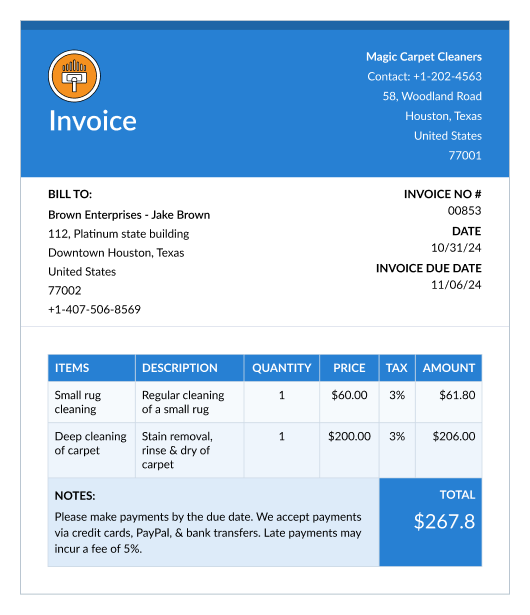
Carpet Cleaning Invoice Template
Carpet cleaning invoice template
Read more
Cleaning Invoice Template
cleaning invoice template
Read more
House Cleaning Invoice Template
House Cleaning Invoice Template
Read more
Non-profit Invoice Template
Non-profit Invoice Template
Read moreCan You Charge Customers a Credit Card Fee? Surcharge Rules for Contractors
Yes, in most states — but there are real rules. Here's where surcharging is legal, how much you can add, and when a cash discount is the smarter move.
Read more9 Cleaning Business Ideas to Bring More Profit
Discover 9 effective Cleaning Business Ideas to boost your revenue and grow your business. Implement these strategies and see the profits roll in.
Read moreTop 23 Cleaning Websites in 2026
Here are 23 of the best cleaning service websites based on their responsiveness, services, cleaning methods, pricing, contract requirements, and more.
Read moreContractor Payment Terms: Standard Terms, Examples & Late-Fee Language
What payment terms contractors actually use. Net 30, deposits, progress payments, 2/10 Net 30, and late-fee language, with examples for residential and commercial work.
Read moreCarpet Cleaning Invoice Template
Carpet cleaning invoice template
Read moreCleaning Invoice Template
cleaning invoice template
Read moreHouse Cleaning Invoice Template
House Cleaning Invoice Template
Read moreNon-profit Invoice Template
Non-profit Invoice Template
Read more