
Key Takeaways
- 01Most junk removal companies price by volume: published 2026 cost guides put a minimum load (1-2 items) at $60-$150, a half truckload at $250-$400, and a full truckload at roughly $550-$850
- 02Junk removal pricing depends on four main factors: type and quantity of junk, distance to the location, time and labor required, and disposal fees
- 03Price each job as labor + transportation + dumping costs, then add your markup - and set a minimum charge so small jobs still cover drive time
- 04Landfill tipping fees average around $62 per ton nationally but vary widely by state, so check your local facility's rates before quoting heavy loads
- 05Account for unforeseen circumstances by adding a buffer to every estimate
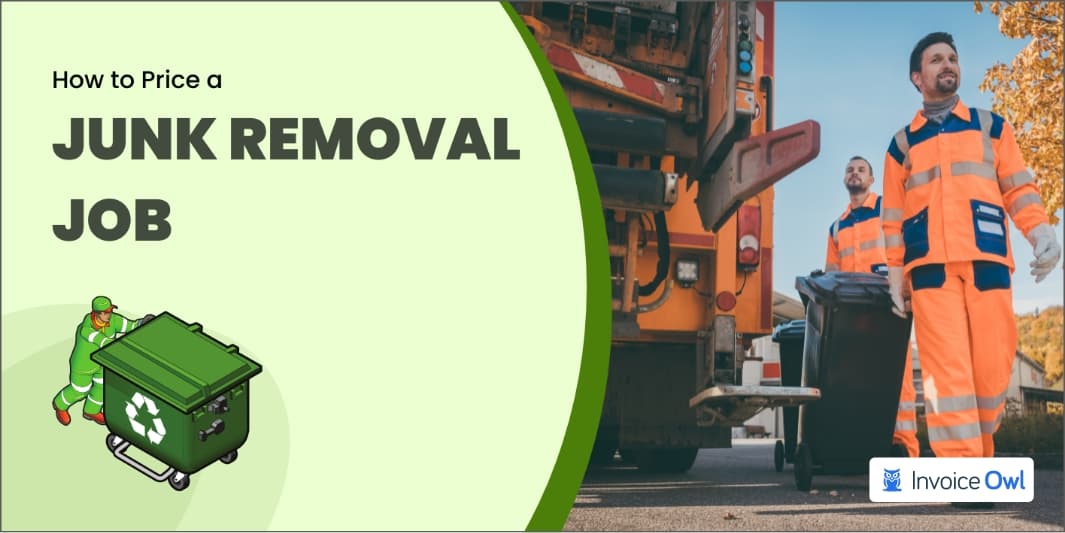
Are you wondering how to price a junk removal job for your business? Pricing your junk removal services can be a difficult process as it requires carefully weighing a number of variables, including:
- The type and quantity of junk
- The time and manpower needed
- Disposal costs, etc.
However, with the appropriate approach (as we will show you), you can make it much easier.
In this post, we'll discuss the primary elements that impact junk removal pricing and examine the various pricing strategies as a contractor you can use.
We will also assist you in making well-informed pricing decisions - whether you're just starting your junk removal service or trying to improve your pricing strategy.
What Junk Removal Companies Charge in 2026
Before setting your own prices, know what the market bears. Most junk removal companies price by volume — how much space the load takes up in the truck. Published 2026 cost guides put typical full-service rates in these ranges:
Typical Junk Removal Rates by Load Size
| Load size | What it covers | Typical price range |
|---|---|---|
| Minimum load (1/8 truck) | 1-2 small items - a microwave, a chair, a few boxes | $60-$150 |
| Quarter truckload | A couch and a few boxes, or a small appliance set | $120-$200 |
| Half truckload | A small room cleanout | $250-$400 |
| Full truckload | A garage or estate cleanout (roughly 15 cu yd) | $550-$850 |
Most residential jobs land between $150 and $350. Treat these as sanity checks, not a price list — your actual costs (below) decide what you can profitably charge in your market.
Factors that Affect Junk Removal Pricing
There are a number of variables that can influence the total cost when it comes to pricing a junk removal job. You can develop a fair and competitive pricing strategy by being aware of these factors and how they affect pricing.
So here are the 4 main elements that influence the cost of junk removal:
1. The amount and type of junk
The biggest factor that influences pricing is the quantity and kind of junk that needs to be removed. Most junk removal companies decide their cost based on the amount of junk being removed, such as by the truckload or the number of items.
Due to the additional labor and equipment needed to remove heavier items, such as appliances and furniture, the cost may also be higher.
Moving away a small pile of used clothing and books might only cost $100, but removing a sizable pile of construction waste might run you $500 or more.
2. The distance to the junk's location
The location of the junk and its distance from your business can affect pricing. The company may charge more for travel time and expenses if the junk is located far from the business.
Furthermore, if the junk is in a difficult-to-reach location, like a basement or attic, it might also need more labor and equipment, which can raise the overall cost.
If a job requires a business to travel more than 30 miles from its base location, junk removal companies might charge an extra $50.
3. The time and labor required to remove the junk
The larger and more complicated a job, the more time, equipment, and effort you need to complete it. Thus, higher will be the junk removal cost.
The need to disassemble or cut the junk into smaller pieces in some situations to remove it can also add to time and labor costs.
It might cost $300 or more to remove and haul away large appliances, which requires two workers and several hours of labor. Whereas for lightweight garbage, which requires only an hour for one worker to complete, the junk removal cost may only be $50.
4. The disposal fees
Many items that are regarded as "junk" need to be handled carefully and disposed of differently, as they cannot be disposed of in standard trash cans. This might lead to extra costs and fees that are passed on to the customer.
Your biggest recurring disposal cost is the landfill tipping fee. The national average is around $62 per ton (per the Environmental Research & Education Foundation's most recent survey), but it varies widely by state — from roughly $30 per ton in parts of the South to well over $100 in parts of the Northeast and Alaska. Check your local transfer station or landfill's posted rates and build them into every quote.
A job involving only common household items may cost much less than one requiring the disposal of hazardous waste such as cleaning solvents, spent acids & bases, etc. Mattresses, tires, refrigerants, and electronics often carry per-item surcharges at the landfill, too.
These are the 4 factors that affect the pricing of a junk removal service. However, none can affect your junk removal prices as much as profit, labor costs, and taxes. These 3 are inseparable from every project you undertake.
So, decide the wages of your servicemen and know the rate of taxes in your region to determine your prices such as you make a sufficient profit.
Now let's see how you can set the prices for your junk removal company.
How to Price a Junk Removal Job?
You have understood some important factors that affect your junk removal costs. But how exactly should you price them? Here are the steps you can follow:
Step 1: Know the exact requirements of your client
How can you price a job accurately without knowing what you have to do in it? Thus, you cannot take this lightly.
Know exactly what you have got to do by finding:
- What junk is it? - Construction debris, yard debris, hazardous materials, etc.
- How much is it? - Approximate truckload volume of the waste.
- Where do you have to pick it up from? - Is it near or far away from your office?
- How can you dispose of it? - Dumping into the local landfill or something else?
The answers to these questions affect the total cost incurred by you. And this brings us to our next step.
Step 2: Determine the cost of the project
All other details aside, you will need to figure out the total cost of completing the whole project. It is this amount on top of which you will be able to add profit for your junk removal business.
If you fail to measure it accurately, your pricing for the project may not turn out to be profitable for you. So how can you determine your total cost for completing the project?
First, understand the various costs that will add up in it:
- Labor costs
- Transportation costs
- Dumping costs
The cost of dumping and transportation relies more on your experienced guess. However, the labor cost is a more quantified entity as you can determine the hourly wage you will pay to your staff working on the project. Our free labor cost calculator helps you get this number right, including payroll taxes and overhead.
Step 3: Add in your profit and taxes
Now comes adding the fuel of any business - profit. So decide on the amount you can add to your total cost of the project to keep your pricing competitive. A markup calculator makes it quick to see what different markup percentages do to your final price and margin.
This will go as your profit. But we suggest you refrain from being overly greedy and not keep the price of your trash removal services too high.
Otherwise, you will run the risk of not being able to convert a prospect into a paying customer.
You will also need to add the appropriate taxes as per your region.
- Labor Cost = Hourly Wage x Number of Hours x Number of Workers
- Total Cost = Labor + Transportation + Dumping
- Price = Total Cost + Markup
Say you quote a basement cleanout that will fill half your truck. Two workers at $22/hour for 2.5 hours is $110 in labor. The site is 20 minutes away — call it $30 in fuel and vehicle costs. You estimate 800 lbs of mixed junk, and your landfill charges $70/ton, so dumping runs about $28. Total cost: $168. Add a 50% markup and you quote $250 — right in the typical half-truckload range, with roughly $82 of gross profit for your business.
Easy, right? But you can make it more accurate by keeping the following tips in mind.
Tips for Pricing Junk Removal Jobs
1. Research competitors' pricing
Even though your pricing may vary from that of your competitors, the fact is that nobody wants to pay a premium for trash removal. Thus, you need to keep your pricing competitive and provide value for money.
So, find out how much your competitors are charging for their services and how they vary from yours. If their services are more affordable, spy on how they are able to pull that off and yet make a profit.
You can then use similar tactics to be affordable while providing better services to be able to stand out from the rest.
2. Consider your margins
No matter how affordable the pricing you keep, the truth is you need to make a decent profit. Or else you won't be able to sustain your business for long.
Don't forget your margins just to compete with others on pricing.
So figure out your bare minimum business operation and project execution costs which may include:
Cost Breakdown: Business vs. Project
| Business Operation Costs | Project Execution Costs |
|---|---|
| Office rent | Total wage provided to your workers for the project |
| Taxes | Transportation |
| Phone bills | Waste processing and dumping |
| Equipment or truck maintenance | |
| Insurance and licenses | |
| Invoicing software | |
| Marketing and promotion |
Keep both of these things in mind when giving a cost estimate to your client. So with clarity of your costs, you can then add a margin to make the project profitable.
3. Account for unforeseen circumstances
In any business, unexpected events are bound to arrive. And they can affect your business in two ways:
-
Customer satisfaction Such unaccounted events may affect the quality of your services or even fail you to deliver on your promises. This will obviously make a dent in customer satisfaction if not tackled properly.
-
Profit margin No matter how proactively you try to calculate your costs, you are bound to miss to account for these unexpected events. So to prevent them from eating up your margins, you can add a buffer for them in each estimate you create for a project.
4. Use reliable invoicing software
To come up as a reliable service, you need to show professionalism in every aspect of your business. Thus, you cannot ignore providing accurate estimates and branded invoices to your clients. A ready-made junk removal estimate template and junk removal invoice template give you a professional starting point.
So try using invoicing software like InvoiceOwl from the start of your junk removal business. And if you're still setting up shop, our guide on how to start a junk removal business covers everything from registration to your first truck.
Come Up as a Professional Junk Removal Business
Send accurate estimates and invoices to your clients with just a few clicks. InvoiceOwl makes pricing and billing effortless for junk removal services.
Start Your FREE TrialFrequently Asked Questions
The type of job and your business model will determine this. Jobs requiring a lot of labor or equipment may benefit from billing by the hour. Whereas smaller or easier jobs may benefit from billing by the job. You might also think about presenting the customer with a choice between the two options.
Consider the value of your services in comparison to those of your competitors after analyzing local market rates. The key is to provide value for money.
The cost of disposal can change depending on what kind of waste is being disposed of. Make sure to investigate local disposal costs and factor them into your pricing plan. To lower disposal costs and draw in environmentally conscious clients, you might also think about providing eco-friendly disposal options like recycling or donation of items.
Published 2026 cost guides put most residential junk removal jobs between $150 and $350. By load size, expect roughly $60-$150 for a minimum load of one or two items, $250-$400 for a half truckload, and $550-$850 for a full truckload. Rates vary by region, so check what competitors in your area actually charge.
Set a minimum that covers a round trip even when the load is tiny: your drive time, fuel, and disposal minimums, plus profit. For most markets that lands somewhere between $75 and $150. Without a minimum charge, single-item pickups on the far side of town will quietly lose you money.
Conclusion
This is how you price your junk hauling services. It is all about hitting the sweet spot between your costs and your profit. This is why it is imperative for you to know your numbers accurately when deciding on your pricing — and why estimating software that keeps your quotes consistent pays for itself quickly.
Related Resources

14 Actionable Accounting Tips for Small Business Owners
New to finance? Discover 14 simple small business accounting tips to track revenues, expenses, and costs, and grow your business effectively.
Read more
Construction Profit Margins: How to Track and Increase it
Learn how to track and increase construction profit margins with expert strategies. Maximize profits and ensure sustainable business growth. Start today.
Read more
Can You Charge Customers a Credit Card Fee? Surcharge Rules for Contractors
Yes, in most states — but there are real rules. Here's where surcharging is legal, how much you can add, and when a cash discount is the smarter move.
Read more
9 Cleaning Business Ideas to Bring More Profit
Discover 9 effective Cleaning Business Ideas to boost your revenue and grow your business. Implement these strategies and see the profits roll in.
Read more
Top 10 FreshBooks Alternatives for Efficient Invoice Management in 2025
Explore the top alternatives to FreshBooks for 2026. Compare features and pricing to find the best fit for your business needs.
Read more
The Ultimate Guide to HoneyBook Alternatives for Small Businesses in 2025
Explore the best HoneyBook alternatives and competitor for 2026. Compare features & pricing to find the perfect fit for your business.
Read more
10 Best QuickBooks Alternatives You Should Consider
Looking for a QuickBooks alternatives? Discover the top 10 invoice software options for businesses in 2025 that fit your pricing & feature requirements.
Read more
Michigan Plumbing License: Steps to Becoming a Licensed Plumber
Get your Michigan plumbing license with our step-by-step guide! Learn the requirements, costs, and process to become a licensed plumber and start your business.
Read more14 Actionable Accounting Tips for Small Business Owners
New to finance? Discover 14 simple small business accounting tips to track revenues, expenses, and costs, and grow your business effectively.
Read moreConstruction Profit Margins: How to Track and Increase it
Learn how to track and increase construction profit margins with expert strategies. Maximize profits and ensure sustainable business growth. Start today.
Read moreCan You Charge Customers a Credit Card Fee? Surcharge Rules for Contractors
Yes, in most states — but there are real rules. Here's where surcharging is legal, how much you can add, and when a cash discount is the smarter move.
Read more9 Cleaning Business Ideas to Bring More Profit
Discover 9 effective Cleaning Business Ideas to boost your revenue and grow your business. Implement these strategies and see the profits roll in.
Read moreTop 10 FreshBooks Alternatives for Efficient Invoice Management in 2025
Explore the top alternatives to FreshBooks for 2026. Compare features and pricing to find the best fit for your business needs.
Read moreThe Ultimate Guide to HoneyBook Alternatives for Small Businesses in 2025
Explore the best HoneyBook alternatives and competitor for 2026. Compare features & pricing to find the perfect fit for your business.
Read more10 Best QuickBooks Alternatives You Should Consider
Looking for a QuickBooks alternatives? Discover the top 10 invoice software options for businesses in 2025 that fit your pricing & feature requirements.
Read moreMichigan Plumbing License: Steps to Becoming a Licensed Plumber
Get your Michigan plumbing license with our step-by-step guide! Learn the requirements, costs, and process to become a licensed plumber and start your business.
Read more14 Actionable Accounting Tips for Small Business Owners
New to finance? Discover 14 simple small business accounting tips to track revenues, expenses, and costs, and grow your business effectively.
Read moreConstruction Profit Margins: How to Track and Increase it
Learn how to track and increase construction profit margins with expert strategies. Maximize profits and ensure sustainable business growth. Start today.
Read moreCan You Charge Customers a Credit Card Fee? Surcharge Rules for Contractors
Yes, in most states — but there are real rules. Here's where surcharging is legal, how much you can add, and when a cash discount is the smarter move.
Read more9 Cleaning Business Ideas to Bring More Profit
Discover 9 effective Cleaning Business Ideas to boost your revenue and grow your business. Implement these strategies and see the profits roll in.
Read moreTop 10 FreshBooks Alternatives for Efficient Invoice Management in 2025
Explore the top alternatives to FreshBooks for 2026. Compare features and pricing to find the best fit for your business needs.
Read moreThe Ultimate Guide to HoneyBook Alternatives for Small Businesses in 2025
Explore the best HoneyBook alternatives and competitor for 2026. Compare features & pricing to find the perfect fit for your business.
Read more10 Best QuickBooks Alternatives You Should Consider
Looking for a QuickBooks alternatives? Discover the top 10 invoice software options for businesses in 2025 that fit your pricing & feature requirements.
Read moreMichigan Plumbing License: Steps to Becoming a Licensed Plumber
Get your Michigan plumbing license with our step-by-step guide! Learn the requirements, costs, and process to become a licensed plumber and start your business.
Read more