Key Takeaways
- 01No — an invoice by itself is not a contract. It's a one-sided request for payment, and it lacks the mutual agreement that makes a contract binding.
- 02A contract requires an offer, acceptance, and an exchange of value. An invoice is created after the agreement, so it can't prove the client ever accepted your terms.
- 03An invoice can still serve as evidence of an agreement in a payment dispute, especially when it's detailed and the client paid similar invoices before.
- 04The reliable setup for contractors: get a signed estimate or contract before the work starts, then invoice against it.
- 05Contract enforceability rules vary by state — for large jobs or recurring disputes, have an attorney review your paperwork.
No — an invoice on its own is not a contract. An invoice is a one-sided document: you create it, you set out what's owed, and you send it after the work is done. What it lacks is the heart of a contract — proof that both parties agreed to the terms before the exchange happened. That's why a client can dispute an invoice in a way they can't easily dispute a signed agreement.
That doesn't make invoices legally meaningless. A detailed invoice is strong evidence of a business relationship, and courts routinely consider invoices in payment disputes. But if you want to actually ensure clients pay on time, the dependable combination is a signed contract or signed estimate before the work starts, followed by an invoice that matches it.
This guide covers what separates the two documents, what belongs on each, and how to put together a contract that will hold up.
What is an Invoice? (Pros & Cons)
Invoices are documents that service providers send to clients to collect a payment, and purchased goods or services are included in this document itself. Invoices can also create legal records if they contain the names of the seller and client, product descriptions, and prices. If you fixed the roof, did the makeup, or launched a consulting business, you may need to send an invoice.
You can employ invoicing software like InvoiceOwl to draft a professional-looking invoice that gets you paid faster.
- Payment terms can be set up, so you receive payment for your efforts
- Quick payments - customers are prompted to pay for services provided
- Clients are reminded of their liabilities through detailed billing
- Helpful for keeping records - the IRS generally recommends keeping them 3-7 years depending on the situation
- Opportunity to present your brand and company positively with professional design
- Incorrectly drafted or vaguely worded documents can lead to disputes or delay payments
- Invoices can be challenged if product sales or work hours are not meticulously recorded
- Late invoices may cause customers to be relaxed about settling their debts
If you are concerned about the invoicing process, no worries; you can move to InvoiceOwl, and you won't face problems generating professional invoices.
What is a Contract? (Pros & Cons)
Contracts are essential to business. A legal contract is a legally binding document between the parties. Typically, a legally binding contract clearly explains all parties' expectations, laying out the agreement's details. A contract may include information about payments, materials, timelines, and how disagreements between the parties involved can be resolved.
- Verifies what you and the other party agreed to
- Makes the agreement clear from the beginning, preventing future misunderstandings
- Terms are documented and don't change, providing security and peace of mind
- Decreases likelihood of disputes regarding responsibilities and payment
- Provides a framework for resolving disputes
- Limited flexibility - restrictions may affect future decisions
- Time-consuming - takes more time to write up than verbal agreements
- Both parties may not understand complex legal terms without legal assistance
Writing a legal document can be time-consuming, but it can make compliance easier and protect your business interests.
Understanding Invoices vs. Contracts: Key Differences
The core difference is agreement. A contract is a document in which one party specifies terms and the other party accepts them — both sides sign on to the deal before it happens. An invoice is a one-way request: it asks for payment for goods or services one party provided to the other, and the client never formally accepts its terms in advance.
A contract is usually a written document that both parties sign, but it doesn't have to be paper. A contract can be formed verbally (though verbal agreements are much harder to prove and enforce), and when both parties explicitly agree to terms in electronic communication — an email, a text message, or an e-signed estimate — that agreement can be binding too. The same logic applies to related documents: a purchase order, for example, can become a binding contract once the seller accepts it.
Contract enforceability rules — including when a contract must be in writing — vary by state. For big-ticket jobs, get your standard contract reviewed by an attorney licensed in your state.
What Makes an Invoice Hold Up? Essential Components
A complete, detailed invoice won't turn into a contract, but it does two important jobs: it gets you paid faster, and it becomes credible evidence of the business relationship if a payment dispute ever ends up in front of a mediator or a small claims judge. To do both, an invoice needs these components:
Clear payment terms matter most: a due date like net 30 spelled out on the invoice removes the "I didn't know when it was due" excuse. A free invoice generator will include every field above by default, so nothing gets left off.
Ready to Create Professional Invoices?
Join 100,000+ contractors using InvoiceOwl to create legally compliant invoices that get you paid faster.
Start Your FREE TrialCreating Legally Binding Contracts: Step-by-Step Guide
To protect your legal rights, contracts are a great choice. Businesses and significant asset purchases require them. In most cases, verbal agreements aren't enforceable, so it is best to write them down.
Here are the step-by-step instructions for creating a contract:
Step 1. Information gathering
List the parties' names and affiliations and the contract's effective date at the top of the page. For example, "XYZ Company agrees to the terms and conditions contained herein on this 1st of January 2022."
Step 2. List your offers/services
Next, you will need to describe or list the products or services you are offering and expect to receive payment in exchange for them. In this section, you should get very specific with the terms you are using since general terms may be interpreted differently.
As a business owner, you would rather not be on the receiving end of an agreement where the client can pressure you to work harder than you want to.
Step 3. Determine term length
The next step involved is specifying the duration of your contract. Depending on the company, they may end after a certain period, like 90 days, or specify a specific date for termination. It is also possible to indicate in this section that your customer is willing to work with you continuously.
Step 4. Lay out the consequences
The business world is full of breach-of-contract and negligence claims, so spell out the consequences: what happens if the client doesn't pay (late fees, work stoppage), and what makes the agreement null and void. Customers who understand the penalties up front are far less likely to test them.
Step 5. Defining the terms of the dispute resolution
How does your company handle disputes? This question has a lot of options. One option would be to allow traditional civil litigation methods. Mediation or arbitration option, however, could be enforced as an alternative dispute resolution method.
Step 6. Create signature and date lines
A contract isn't enforceable until both parties have signed it, so include a signature and date line for each party. The order of signing doesn't matter — there's no advantage to signing first or last. To skip the print-sign-scan shuffle entirely, collect e-signatures on your estimates and agreements; electronically signed documents are legally recognized in the U.S. under the federal E-SIGN Act.
Conclusion
An invoice and a contract do different jobs, and a healthy business uses both: the contract protects your rights by locking in the agreement before work starts, and the invoice collects the payment that agreement promised. Send a contract (or a signed estimate) first, invoice against it after, and keep both documents consistent — that combination is what actually gets small businesses paid on time.
Frequently Asked Questions
On its own, no. An invoice is a request for payment created by one party after the fact — it doesn't prove the client agreed to your terms, which is the defining feature of a contract. In a dispute, an invoice can serve as evidence that an agreement existed (especially alongside emails, signed estimates, or a history of paid invoices), but you shouldn't rely on an invoice alone to bind a client.
Yes — that's precisely what a contract is for. A valid contract defines and governs each party's rights and obligations, and involves either the transfer of goods, services, or money, or a promise to transfer them later. As long as there's an offer, acceptance, and an exchange of value, the agreement is enforceable.
Yes. Businesses invoice customers without a formal contract all the time, and the client still owes you for work they requested and received. The catch is enforcement: without a signed agreement, collecting from a client who disputes the bill is harder and rests on whatever evidence you have — estimates, emails, texts, and the invoice itself. For anything beyond small, routine jobs, get a signed estimate first.
The missing ingredient is acceptance. If a client explicitly agrees to your documented terms before the work happens — signs your estimate, accepts terms by email, or issues a purchase order you accept — then the invoice that follows is backed by a real agreement, and the paper trail together can bind both parties. The invoice documents the deal; the client's advance acceptance is what makes the deal enforceable. Exactly how much weight that trail carries varies by state, so ask a local attorney if the stakes are high.
Generally yes — you can pursue an unpaid invoice in small claims court (limits vary by state, commonly $5,000–$20,000). You'll need to show the client requested the work and you performed it; a detailed invoice, a signed estimate, photos of completed work, and correspondence all help. Many contractors resolve unpaid invoices with payment reminders and late-fee terms before it ever gets that far.
Related Resources
Can You Charge Customers a Credit Card Fee? Surcharge Rules for Contractors
Yes, in most states — but there are real rules. Here's where surcharging is legal, how much you can add, and when a cash discount is the smarter move.
Read more
How to Bid For Landscaping Jobs
Learn how to write a receipt with key elements, templates, and digital solutions for proper formatting and best practices in business record-keeping.
Read more
How to Improve Cash Flow for Small Business: Expert Guide
Learn strategies for how to improve cash flow for small business, including managing expenses, invoicing promptly, and exploring financing options.
Read more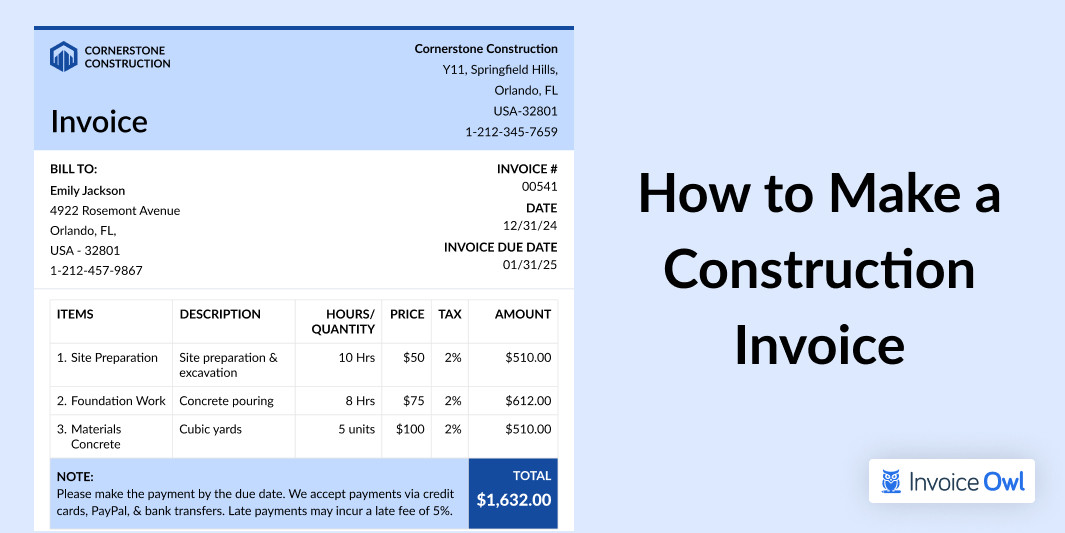
How to Make a Construction Invoice: Guide + Template
Learn how to make a construction invoice with this easy guide. Discover tips, free templates, and key details to create professional invoices for your business.
Read more
How to Write a Credit Memo Effectively: A Complete Guide
A credit memo is a document issued by the seller to show the remaining business in the account of the buyer. The blog will help you to understand the definition of a credit memo and how to write a credit memo effectively.
Read more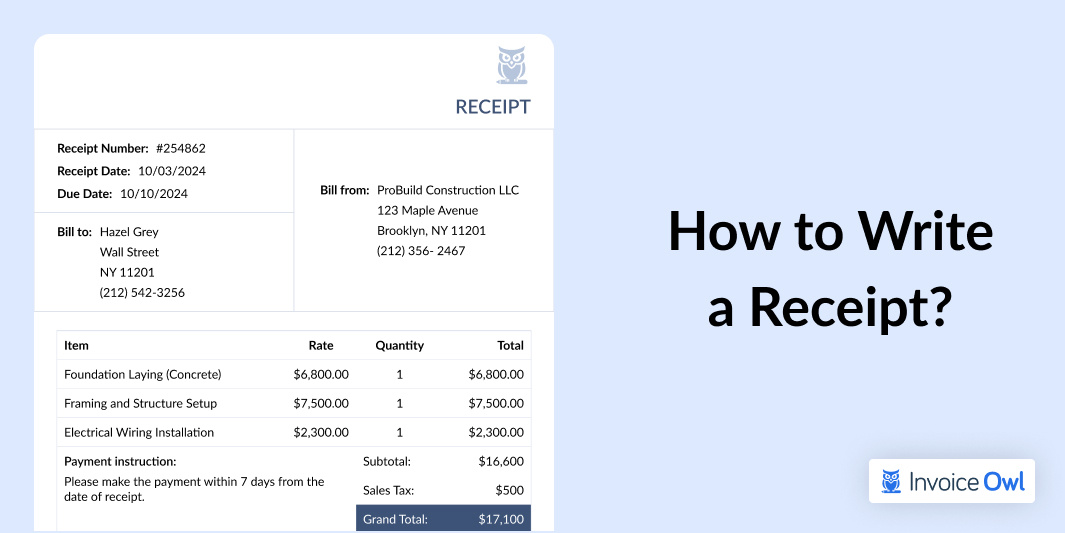
How to Write a Receipt: Complete Guide with Templates
Learn how to write a receipt with key elements, templates, and digital solutions for proper formatting and best practices in business record-keeping.
Read more
Invoicing Software for Mac in 2026 (Features & Pricing Compared)
Discover the best invoicing and billing software for Mac, MacBook, and macOS. Explore free trial apps with top features, pricing, and seamless invoicing tools.
Read more
5 Best Pest Control Software for 2026
Grow Your pest control business with pest control software that makes it easy to manage the estimating, invoicing, & payment process you need for your clients.
Read moreCan You Charge Customers a Credit Card Fee? Surcharge Rules for Contractors
Yes, in most states — but there are real rules. Here's where surcharging is legal, how much you can add, and when a cash discount is the smarter move.
Read moreHow to Bid For Landscaping Jobs
Learn how to write a receipt with key elements, templates, and digital solutions for proper formatting and best practices in business record-keeping.
Read moreHow to Improve Cash Flow for Small Business: Expert Guide
Learn strategies for how to improve cash flow for small business, including managing expenses, invoicing promptly, and exploring financing options.
Read moreHow to Make a Construction Invoice: Guide + Template
Learn how to make a construction invoice with this easy guide. Discover tips, free templates, and key details to create professional invoices for your business.
Read moreHow to Write a Credit Memo Effectively: A Complete Guide
A credit memo is a document issued by the seller to show the remaining business in the account of the buyer. The blog will help you to understand the definition of a credit memo and how to write a credit memo effectively.
Read moreHow to Write a Receipt: Complete Guide with Templates
Learn how to write a receipt with key elements, templates, and digital solutions for proper formatting and best practices in business record-keeping.
Read moreInvoicing Software for Mac in 2026 (Features & Pricing Compared)
Discover the best invoicing and billing software for Mac, MacBook, and macOS. Explore free trial apps with top features, pricing, and seamless invoicing tools.
Read more5 Best Pest Control Software for 2026
Grow Your pest control business with pest control software that makes it easy to manage the estimating, invoicing, & payment process you need for your clients.
Read moreCan You Charge Customers a Credit Card Fee? Surcharge Rules for Contractors
Yes, in most states — but there are real rules. Here's where surcharging is legal, how much you can add, and when a cash discount is the smarter move.
Read moreHow to Bid For Landscaping Jobs
Learn how to write a receipt with key elements, templates, and digital solutions for proper formatting and best practices in business record-keeping.
Read moreHow to Improve Cash Flow for Small Business: Expert Guide
Learn strategies for how to improve cash flow for small business, including managing expenses, invoicing promptly, and exploring financing options.
Read moreHow to Make a Construction Invoice: Guide + Template
Learn how to make a construction invoice with this easy guide. Discover tips, free templates, and key details to create professional invoices for your business.
Read moreHow to Write a Credit Memo Effectively: A Complete Guide
A credit memo is a document issued by the seller to show the remaining business in the account of the buyer. The blog will help you to understand the definition of a credit memo and how to write a credit memo effectively.
Read moreHow to Write a Receipt: Complete Guide with Templates
Learn how to write a receipt with key elements, templates, and digital solutions for proper formatting and best practices in business record-keeping.
Read moreInvoicing Software for Mac in 2026 (Features & Pricing Compared)
Discover the best invoicing and billing software for Mac, MacBook, and macOS. Explore free trial apps with top features, pricing, and seamless invoicing tools.
Read more5 Best Pest Control Software for 2026
Grow Your pest control business with pest control software that makes it easy to manage the estimating, invoicing, & payment process you need for your clients.
Read more